

Mastering the SAT
The SAT is a digital, standardized test used primarily as a college entrance exam.
It is a 2.5 hour adaptive test covering core concepts in Reading, Writing, and Math. The test is designed to test the foundational aspects of high school education, as well as predict student readiness for college. The digital format and the adaptive nature of the test are its key features.
Our SAT Approach
We target the Reading & Writing and Math sections differently:

Reading & Writing
Our tutors start with content knowledge in the Writing half of the section, taught through hand-picked lessons based on each individual student’s needs and scores. In the Reading half of the section, students will work on strategy first, concentrating on improving their overall reading comprehension from the very first session and learning how to break apart difficult passages through exposure to official questions and material. We follow a very specific, results-driven strategy to guide our students through each type of question in the Reading & Writing section.
Math
A mix of strategy and content is where we begin in the Math section. Our tutors will start by evaluating how the student is approaching various types of questions based on their diagnostic test and homework performance, then tailor their sessions to helping students become more efficient and deliberate with their approach.
Our high-achieving students will generally come in with a fundamental understanding of many of the Math concepts from their classes in school, but our tutors will also work to fill in any content gaps that they see as they come up.
Performance
Finally, we have our students put everything that they’ve learned to the test in full-length tests. Students will often take multiple practice tests, at the suggestion of their tutor, to identify progress, where adjustments need to be made, timing difficulties, content gaps, and strategy use. We use student performance on practice tests to predict performance on official tests and adjust the overall tutoring plan.
Individualized for You
Our process is heavily influenced by the students’ timeline and personal goals. A student coming in with three weeks until an official test is going to require a much different approach than a student coming in with three months until an official test, and the way that we set up our curriculum allows for us to make the necessary adjustments to get both of those students over the finish line.
Our Progress Tracking
We track each student’s progress throughout their journey with us. This allows us to view specific progress on individual sections, types of questions, overall score progression, and strategy use. This gives us a more cohesive perspective on student progress and allows us to see, and potentially mediate for, changes in learning growth across the entire process. On our practice tests, we generate reports to determine what is and isn’t working.

We keep in regular communication with our families. Our tutors send short summaries of each session to parents, keeping the line of communication open and giving families the opportunity to ask questions about progress. The office will also do occasional check-ins with parents to make sure that everything is on track.
Lastly, we adhere to a strict timeline. Our tutors have a copy of the SAT timeline with each student’s official test date flagged. When a student has a change in their timeline, either by adding to or changing their official test dates, the tutor will work with the student to reassess the tutoring plan and clearly communicate the changes to both the student and parent.
Our Results
Our students from the 2024-2025 school year saw an average score gain of 164 points.

Quote from S24 on her 12-point gain:

“I started test prep because I knew I needed help learning and practicing for the ACT. I knew that I wouldn't be able to do it alone, and I needed someone to push me. Going to college is very important to me, and I want to make sure that I do everything I can to get as many options as I can so that when the time comes I have a choice of where I want to go.” - SDJA, Class of 2021
SAT Score Gain Hall of Fame
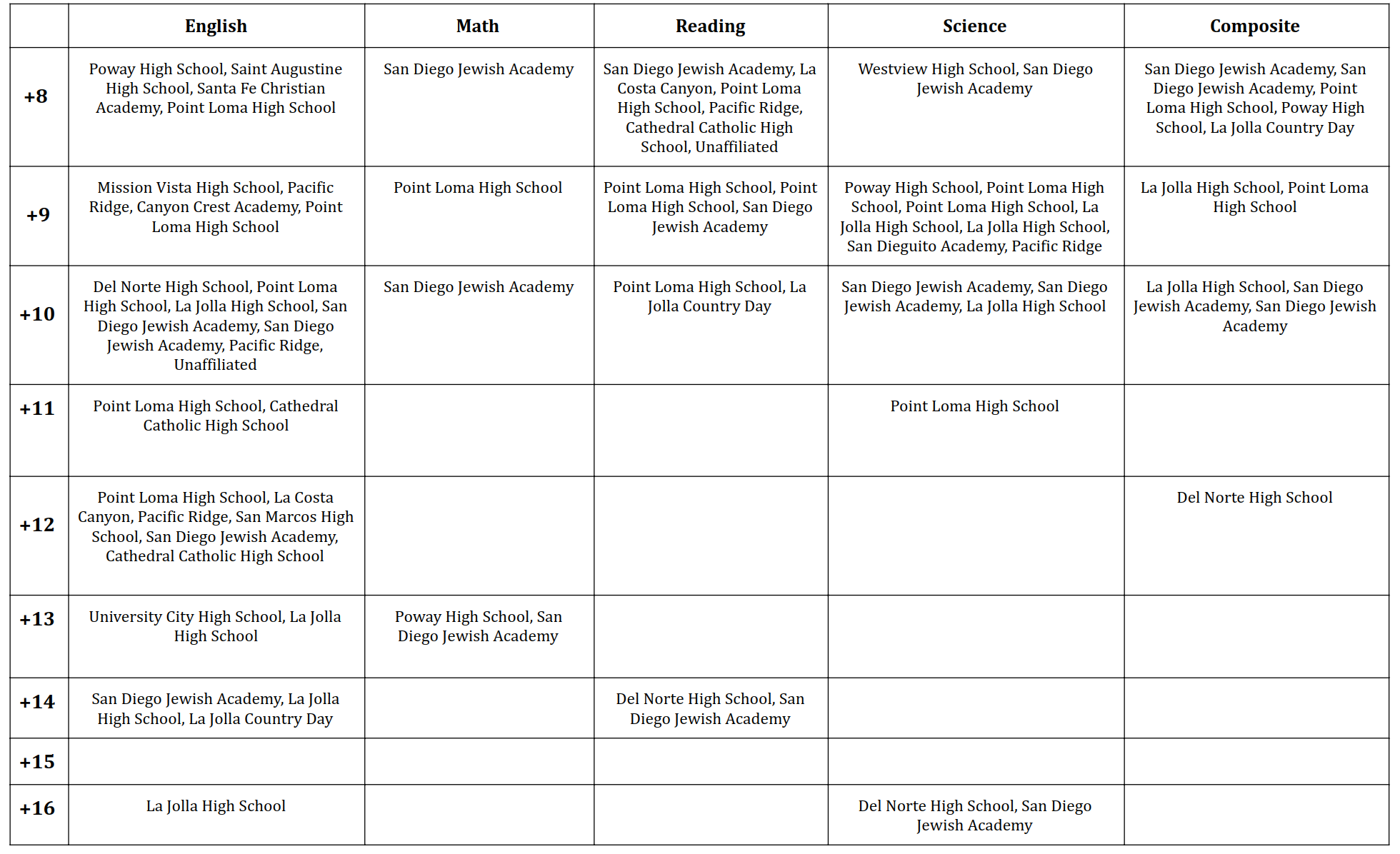
SAT Scores to Beat
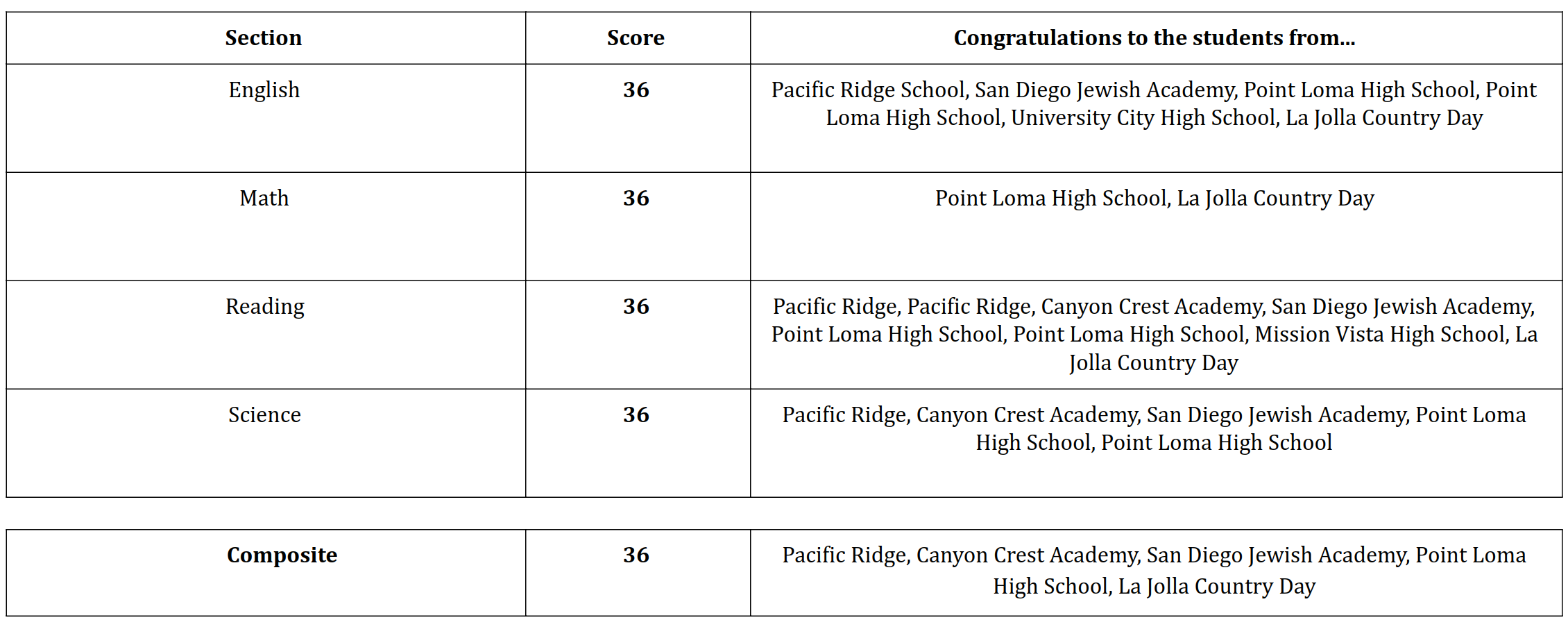
Note: Each school name represents one student.
Frequently Asked Questions
What does it mean that the test is adaptive?
The SAT has two sections (Reading & Writing and Math) with two modules each. In both sections, if the students do well in Module 1, then they will get the harder Module 2. If students miss more questions in Module 1, then they will get the easier Module 2. The easier Module 2 will cap the student’s maximum section score in the 600-650 range.
How is the test scored?
The digital SAT is scored out of a total 1600 points. Each section is scored out of a total 800 points, and the lowest section score a student can achieve is 400.
Are colleges still using test scores for college admissions?
Absolutely! Many schools have shifted back to test-required in the past year, and more schools who are test-optional are making it known that a test score is beneficial. The best information you can now find is on many school’s tours, but you can also seek out a counselor to help you navigate these requirements and preferences.
The one big exception? The UC system has been legally barred from looking at the ACT and SAT (though they still certainly look at your AP scores), and the Cal State system has opted to follow suit and also not look at the ACT and SAT for admissions. If you are only considering looking at these schools, it would be wise to spend your time preparing for your AP exams. If you would like options beyond the California public schools though, it can be very helpful to have a good test score in hand while applying.
Should I submit test scores for a test-optional school?
If you have the ability and opportunity to submit a test score to a test-optional school, it can only add to the strength of your application. While many colleges promised equal opportunities in test-optional admissions this past fall for score and non-score applicants, colleges across the country accepted students who submitted test scores with their application at significantly higher rates. In addition to requiring test scores for select merit scholarships, some test-optional schools may require course placement exams in lieu of SAT scores.
What other benefits come with taking the SAT?
Unsure if preparing for a test is beneficial to your situation? We’re breaking down the reasons behind why students take the standardized tests in our Why Prep? blog series.
Why Prep? Part 1: Fundamental Skill Building
Why Prep? Part 2: Scholarships

Helpful Resources for SAT Students
2026 SAT Dates and Deadlines
Test Date
March 14, 2026
May 2, 2026
June 6, 2026
Registration Deadline
February 27, 2026
April 17, 2026
May 22, 2026
Late Reg. Deadline
March 3, 2026
April 21, 2026
May 26, 2026
Expected Score Release
March 27, 2026
May 15, 2026
June 19, 2026